Showing posts with label Articles. Show all posts

Saturday, August 1, 2026

Open Source Stream Deck Targets Flexibility

August 01, 2026 0
Open Source Stream Deck Targets Flexibility

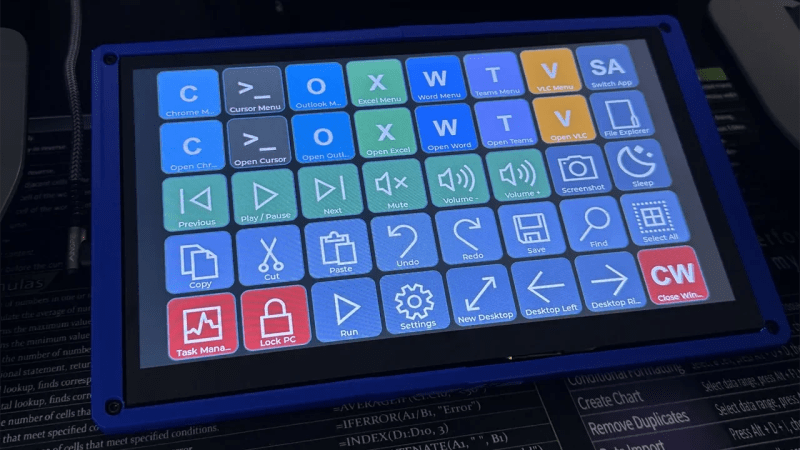
Stream decks are very useful when you’re live on camera and you need to hit some complicated macro at a glance. However, there is sometimes a perception that commercial options are a touch expensive for what they are, an attitude which has spawned many DIY builds. [Fady Faheem] has developed just such a device of his own.

Named Stream32, the build is intended to be simple to understand and adapt to one’s own individual workflow. Putting one together is as easy as buying a display, hooking it up to an ESP32, flashing the firmware, and then adding pages of shortcuts as desired. [Fady] has designed the firmware to be flexible with regards to screen choice — currently, it can be set up for a 4″ Waveshare LCD or a nice roomy 10.1″ display from Elecrow. Since it’s open source, adapting to a wider range of displays is a potential exercise for the builder.

The great thing about custom stream decks is you have all the freedom in the world to customize them to your own specific setup. Play with the code, the functionality, the visual layout—all to suit your own needs. If you’re working on your own custom hardware, be sure to tell us on the tipsline.

Browser-based 3D Editor Covers The Basics While Staying Local

August 01, 2026 0
Browser-based 3D Editor Covers The Basics While Staying Local

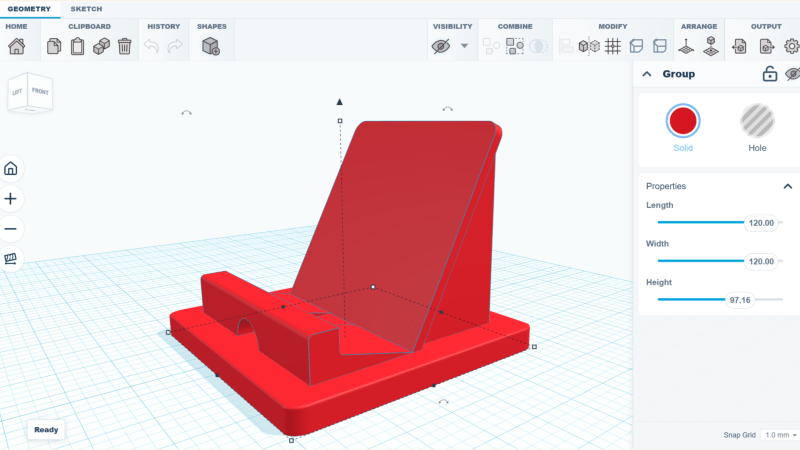
Got an idea and want to make a simple 3D model, but don’t want to install a full-fledged CAD modeling suite and queue up a few hours of tutorial videos? Check out SketchForge, a 3D modeling program that runs locally in one’s browser without any need for an account, or external services.

SketchForge takes a more WYSIWYG approach to 3D modeling by making it easy to put an object together with primitive shapes, and making it extra easy to specify dimensions and align parts with one another. There’s also a sketch feature that makes it easier to create more complex shapes by making a 2D drawing, then extruding or revolving it into a solid. We like that it has STEP format export as an option, making it easy to import your creation into another CAD program of your choice later. Most 3D printer slicers natively support the STEP format nowadays, too.

It’s a bit reminiscent of Tinkercad in concept, but entirely local. It’s still new, but there’s a demo online that gives a good idea of its capabilities if you’d like to give it a spin.

We’re reminded of CaDoodle, another project that takes the “Tinkercad, but local” approach but as a standalone executable, instead of browser-based.


Friday, July 31, 2026

Tiny Desktop Robot Has Radar

July 31, 2026 0

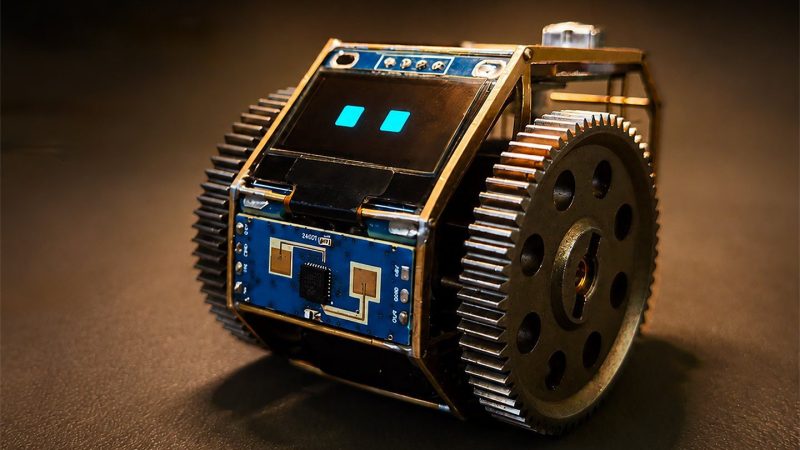
One thing our futuristic world is largely lacking in is droids and robot companions and the like. [solitary dev] is helping to rectify that problem by building a little robot called TongDou.

As [solitary dev] tells it, TongDou is a “tiny open-source desktop gremlin.” An ESP32-S3 serves as TongDou’s brain, buried inside a tasteful brass tube chassis. An OLED display is TongDou’s face, and he uses a pair of wheels driven by gearmotors for locomotion. A speaker plays back pre-recorded voice lines, while a 24GHz radar and an IMU enables TongDou to keep track of the space it’s moving through. They are publishing the design files on Github so other makers can build their own if so desired.

[solitary dev] hopes to develop TongDou into something to make a “workspace feel less dead.” It’s not dissimilar from the way studios used to use robots to liven up otherwise hackneyed movies and TV shows, and we could absolutely use some of that whimsy in the real world. We’ve featured other fun desktop companions before, too. Video after the break.


Hackaday Podcast Episode 380: 3D Printing the Rainbow, IR and IP Camera Hacks, and Americium 241 on the Loose

July 31, 2026 0
Hackaday Podcast Episode 380: 3D Printing the Rainbow, IR and IP Camera Hacks, and Americium 241 on the Loose

Elliot Williams and Al Williams got together to compare notes on the most interesting posts this week on the site. As usual, there are just too many choices, so you’ll have to settle for just the few that can fit in a podcast. The guys were excited about 3D printing — both FDM and SLA — as well as a few camera projects. Ever wanted your own starship? They do, too, and you’ll hear about it along with portable radar and more.

Want to make flexible PCBs? Fill up a carbon dioxide tank? Or play Doom via regular expressions? Tune in, and you’ll find out about those stories and more.

Follow along with the links, and as always, tell us what you think about this episode in the comments! Better still, drop us a note in the mailbag, and you might hear your question on a future episode. You can record audio or send us a message, and one of the hosts will read it on your behalf.

Direct download in IR color-corrected DRM-free MP3.

Episode 380 Show Notes:

News:

Mailbag:

  • [Marcel] wants more info about the next Hackaday Europe, and delivers a great excuse for not making it this year.
  • A note about IRCs and QSL managers from [Reese Johnson].
  • QSL Bureau
    • Drop your comments and questions in audio or text format to mailbag@hackaday.com, and you might hear it on a future podcast!

Interesting Hacks of the Week:

Quick Hacks:

Can’t-Miss Articles:


Hacking a Commercial Colorimeter to add RAL Color Code Support

July 31, 2026 0
Hacking a Commercial Colorimeter to add RAL Color Code Support

When you need to match paint colors, one of the tools you’ll reach for is a deck of reference colors. Another might be a colorimeter. But what if you want both? [hallko1234] created just that by reverse-engineering and then patching a CR4501 colorimeter.

It starts with a problem: every time [hallko1234] needed to check a color, he had to take a reading, write it down, run to the office, match it with a table, and then walk all the way back. That sounds like too much effort. The natural solution, of course, is to automate the process.

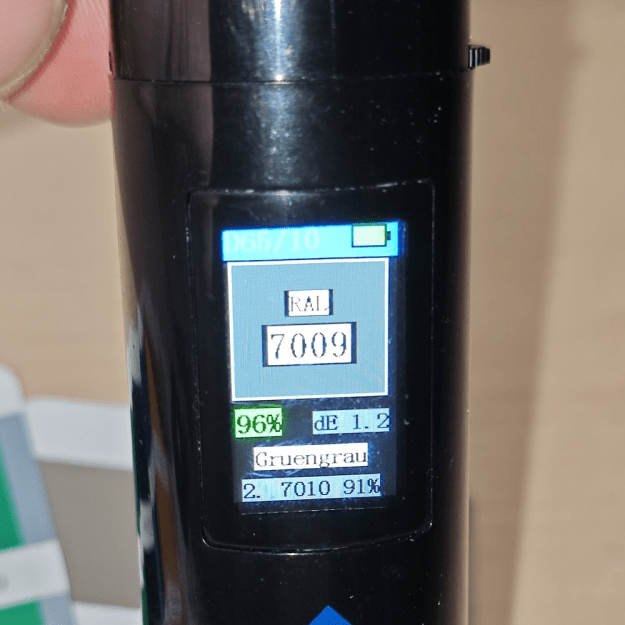
So he did. The CR4501 will happily give you its entire firmware over the debug port, after which it was time for analysis in Ghidra. Some hiccups, brickings and accidental erasure of calibration data later, he finally had a working version. The end result is a simple screen that, after every time you measure, displays the closest RAL color code and how close it is.

On the off chance someone else has the same colorimeter, he even made an online tool to install it for you.