Sunday, January 4, 2026

Sleeping Rough in Alaska with a USPS Cargo Bike

January 04, 2026 0

Out of all 49 beautiful US states (plus New Jersey), the one you’d probably least want to camp outside in during the winter is arguably Alaska. If you were to spend a night camping out in the Alaskan winter, your first choice of shelter almost certainly wouldn’t be a USPS electric cargo trike, but over on YouTube [Matt Spears] shows that it’s not that hard to make a lovely little camper out of the mail bike. 

We’re not sure how much use these sorts of cargo trikes get in Alaska, but [Matt] seems to have acquired this one surplus after an entirely-predictable crash took one of the mirrors off. A delta configuration trike — single wheel in front — is tippy at the best of times, but the high center of gravity you’d get from a loading the rear with mail just makes it worse. That evidently did not deter the United States Postal Service, and it didn’t deter [Matt] either.

His conversion is rather minimal: to turn the cargo compartment into a camper, he only adds a few lights, a latch on the inside of the rear door, and a wood-burning stove for heat. Rather than have heavy insulation shrink the already-small cargo compartment, [Matt] opts to insulate himself with a pile of warm sleeping bags. Some zip-tie tire chains even let him get the bike moving (slowly) in a winter storm that he claims got his truck stuck.

While it might not be a practical winter vehicle, at least on un-plowed mountain roads, starting with an electric-assist cargo trike Uncle Sam already paid for represented a huge cost and time savings vs starting from scratch like this teardrop bike camper we featured a while back. While not as luxurious, it seems more practical for off-roading than another electric RV we’ve seen.

Saturday, January 3, 2026

Apollo Lunar Module Thrust Meter Lives Again

January 03, 2026 0
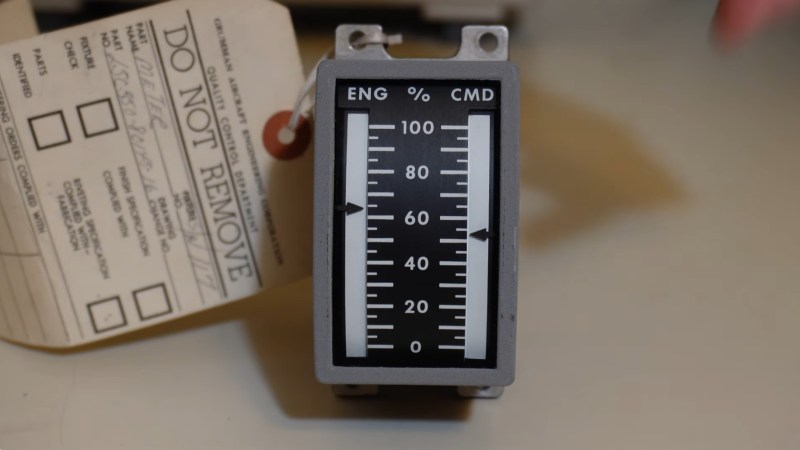
A photo of the thrust meter from the Apollo lunar module

[Mike Stewart] powers up a thrust meter from an Apollo lunar module. This bit of kit passed inspection on September 25, 1969. Fortunately [Mike] was able to dig up some old documentation which included the pin numbers. Score! It’s fun to see the various revisions this humble meter went through. Some of the latest revisions are there to address an issue where there was no indication upon failure, so they wired in a relay which could flip a lamp indicator if the device lost power.

This particular examination of this lunar thrust module is a good example of how a system’s complexity can quickly get out of hand. Rather than one pin there are two pins to indicate auto or manual thrust, each working with different voltage levels; the manual thrust is as given but the auto thrust is only the part of the thrust that gets added to a baseline thrust, so they need to be handled differently, requiring extra logic and wiring for biasing the thrust meter when appropriate. The video goes into further detail. Toward the end of the video [Mike] shows us what the meter’s backlights look like when powered.

If you’re interested in Apollo mission technology be sure to check out Don Eyles Walks Us Through The Lunar Module Source Code.


Teardown of Boeing 777 Cabin Pressure Control System

January 03, 2026 0

Modern passenger airliners are essentially tubes-with-wings, they just happen to be tubes that are stuffed full with fancy electronics. Some of the most important of these are related to keeping the bits of the tube with humans inside it at temperatures and pressures that keeps them alive and happy. Case in point the Boeing 777, of which [Michel] of Le Labo de Michel on YouTube recently obtained the Cabin Pressure Control System (CPCS) for a teardown.

The crucial parts on the system are the two Nord-Micro C0002 piezo resistive pressure transducers, which measure the pressure inside the aircraft. These sensors, one of which is marked as ‘backup’, are read out by multiple ADCs connected to a couple of FPGAs. The system further has an ARINC 429 transceiver, for communicating with the other avionics components. Naturally the multiple PCBs are conformally coated and with vibration-proof interconnects.

Although it may seem like a lot of hardware just to measure air pressure with, this kind of hardware is meant to work without errors over the span of years, meaning significant amounts of redundancy and error checking has to be built-in. Tragic accidents such as Helios Airways Flight 522 involving a 737-300 highlight the importance of these systems. Although in that case human error had disabled the cabin pressurization, it shows just how hard it can be to detect hypoxia before it is too late.


The Setun Was a Ternary Computer from the USSR in 1958

January 03, 2026 0
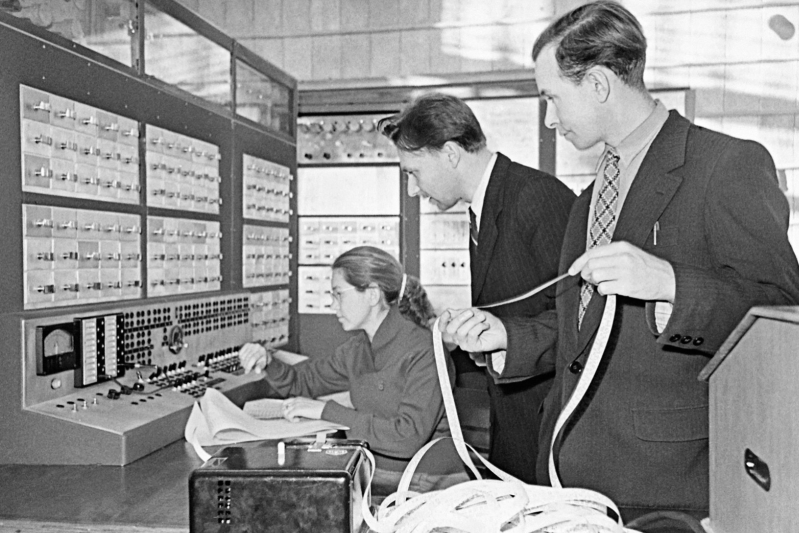
Scientific staff members working on the computing machine Setun

[Codeolences] tells us about the FORBIDDEN Soviet Computer That Defied Binary Logic. The Setun, the world’s first ternary computer, was developed at Moscow State University in 1958. Its troubled and short-lived history is covered in the video. The machine itself uses “trits” (ternary digits) instead of “bits” (binary digits).

When your digits have three discrete values there are a multiplicity of ways of assigning meaning to each state, and the Setun uses a system known as balanced ternary where each digit can be either -1, 0, or 1 and otherwise uses a place-value system in the normal way.

An interesting factoid that comes up in the video is that base-3 (also known as radix-3) is the maximally efficient way to represent numbers because three is the closest integer to the natural growth constant, the base of the natural logarithm, e, which is approximately 2.718 ≈ 3.

If you’re interested to know more about ternary computing check out There Are 10 Kinds Of Computers In The World and Building The First Ternary Microprocessor.


Pickle Diodes, Asymmetric Jacobs Ladders, and Other AC Surprises

January 03, 2026 0

While we’re 100 years past Edison’s fear, uncertainty, and doubt campaign, the fact of the matter is that DC is a bit easier to wrap one’s head around. It’s just so honest in its directness. AC, though? It can be a little shifty, and that results in some unexpected behaviors, as seen in this video from [The Action Lab].

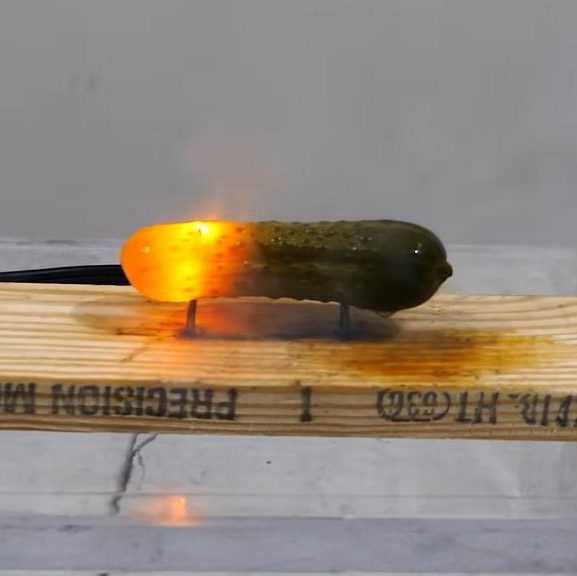
He starts off with a very relatable observation: have you ever noticed that when you plug in a pickle, only half of it lights up? What’s up with that? Well, it’s related to the asymmetry he sees on his Jacobs ladder that has one side grow hotter than the other. In fact, it goes back to something welders who use DC know about well: the Debye sheath.

The arc of a welder, or a Jacobs ladder, or a pickle lamp is a plasma: ions and free electrons. Whichever electrode has negative is going to repel the plasma’s electrons, resulting in a sheath of positive charge around it. This positively-charged ions in the Debye sheath are going to accelerate into the anode, and voila! Heating. That’s why it matters which way the current goes when you’re welding.

With DC, that makes sense. In AC, well — one side starts as negatively charged, and that’s all it takes. It heats preferentially by creating a temporary Debye sheath. The hotter electrode is going to preferentially give off electrons compared to its colder twin — which amplifies the effect every time it swings back to negative. It seems like there’s no way to get a pure AC waveform across a plasma; there’s a positive feedback loop at whatever electrode starts negative that wants to introduce a DC bias. That’s most dramatically demonstrated with a pickle: it lights up on the preferentially heated side, showing the DC bias. Technically, that makes the infamous electric pickle a diode. We suspect the same thing would happen in a hot dog, which gives us the idea for the tastiest bridge rectifier. Nobody tell OSHA.

[The Action Lab] explains in more detail in his video, and demonstrates with ring-shaped electrode how geometry can introduce its own bias. For those of us who spend most of our time slinging solder in low-voltage DC applications, this sort of thing is fascinating.  It might be old hat to others here; if the science of a plain Jacobs ladder no longer excites you, maybe you’d find it more electrifying built into a blade.


Friday, January 2, 2026

Adding Solar Power to an Electric Tractor

January 02, 2026 0
Adding Solar Power to an Electric Tractor
The solar-electric tractor is out standing in its field.

In my country, we have a saying: the sun is a deadly lazer. Well, it’s not so much a folk saying as a meme, and not so much in one country as “the internet”. In any case, [LiamTronix] was feeling those cancer rays this harvest season when running his electric tractor, and realized that– since he’s already charging it with ground-mounted solar panels anyway–if he’s going to build a roof for his ride, he might as well make charge the batteries.

Another bonus is safety: the old Massey-Ferguson at the heart of the electric tractor build didn’t come with any rollover protection from the factory back in the 1960s. Since having however many tons of tractor roll onto you was bad enough before it got a big hefty battery pack, we heartily approve of including a roll cage in this build. Speaking of battery packs, he’s taking this chance to upgrade to a larger LiFePo pack from the LiIon pack he installed when we first featured this conversion in 2024.

Atop the new roll cage, and above the new battery, [Liam] installed four second-hand 225 W solar panels. Since that’s under 1kW even if the panels have not degraded, the tractor isn’t going to be getting much charge as it runs. In the northern winter, [Liam] is only able to pull 80 W from the set. That’s not getting much work done, but who wants a tractor without a cab or heater when it’s below freezing? In the summer it’s a much better story, and [Liam] estimates that the roof-mounted panels should provide all of the energy needed to run the tractor for the couple hours a day he expects to use it.

If you’re wondering how practical all this is, yes, it can farm  — we covered [Liam] putting the project through its paces in early 2025.


Jailbreaking the Amazon Echo Show

January 02, 2026 0

As locked-down as the Amazon Echo Show line of devices are, they’re still just ARM-based Android devices, which makes repurposing it somewhat straightforward as long as what you want is another Android device.

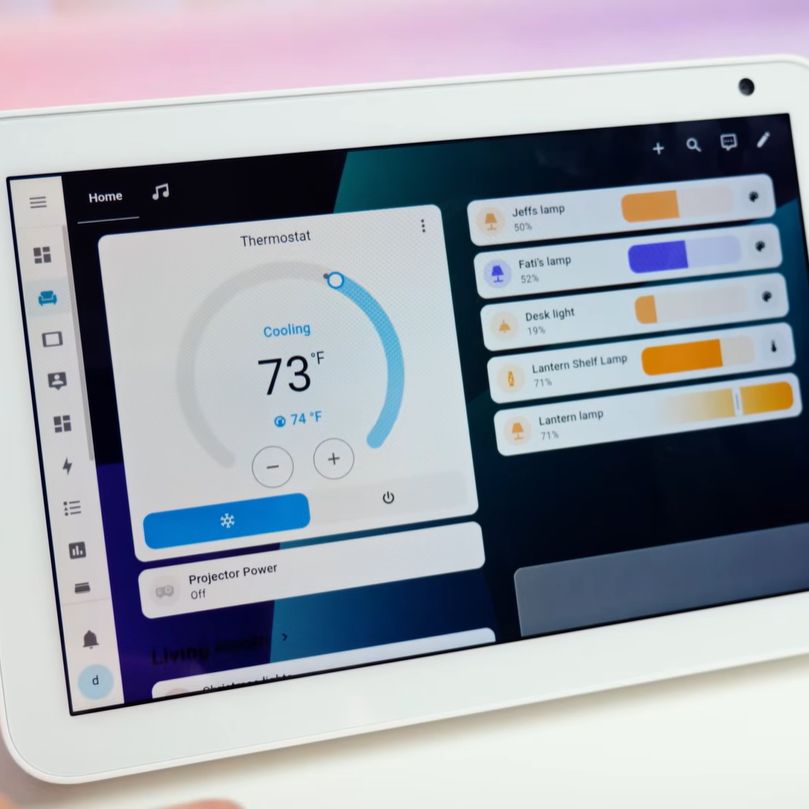
Running Home Assistant on an Echo Show 8 with LineageOS. (Credit: Dammit Jeff, YouTube)
Running Home Assistant on an Echo Show 8 with LineageOS.

In this case, we’re talking about the first-generation Amazon Echo Show 8, which is a 2019-era device that got jailbroken back in November by [Rortiz2]. The process was then demonstrated in a video by [Dammit Jeff].

Currently only two devices are supported by this jailbreak, with the Echo Show 5 being the other one. If there’s enough interest, there doesn’t appear to be any technical reason at least for why this support couldn’t be extended to other devices. One major reason for jailbreaking is to put LineageOS on your Echo device courtesy of these Echo Show devices recently beginning to show advertisements, with no way to disable this.

The process of jailbreaking and installing the LineageOS ROM is somewhat long as usual, with plenty of points where you can make a tragic mistake. Fortunately it’s pretty simple as long as you follow the steps and afterwards you can even install the Google apps package if that’s your thing. Just mind the 1 GB RAM and 8 GB of storage on the Echo Show 8. In the case of [Jeff] he mostly replicated the home automation and entertainment features of Amazon’s FireOS with far less locked-down alternatives like Home Assistant.