Saturday, August 29, 2026

Motorized Planer Height Adjustment Dials In

August 29, 2026 0
Motorized Planer Height Adjustment Dials In

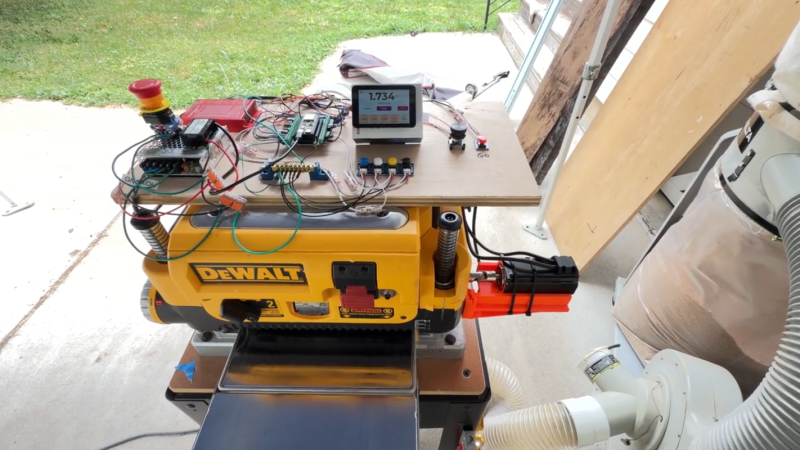
Having access to a planer opens up a lot of options for woodworking. It enables a craftsman to work with much rougher lumber and the finished results generally have tighter tolerances. But as [DendroLabsDev] found out, the height adjustment wheel on a planer needs a lot of turns to go from its lowest to highest position, and this gets tiresome when greasing parts during maintenance. So what started as a quick hack to quickly perform this single maintenance task eventually resulted in this programmable height adjustment that’s in use on the planer full-time now.

The motor attached to the height adjustment for the planer is a stepper motor, capable of around 1000 steps per inch. Since revolutions on this tool with the stock wheel adjust only a small amount per revolution, this can in theory enable very small tolerances to be dialed in consistently. Not only that, but [DendroLabsDev] has programmed it with a few different modes, the first of which allows a board to be planed to a certain thickness by making several passes, mimicking the workflow of a human-controlled machine. Then a device to zero the position was added, and then the ability to save the height adjustments to make replication across different boards was added, and then a mode to step through set amounts per pass.

What [DendroLabsDev] has essentially made is a high-dollar planer control that is actually available in the most expensive planers, but adapted for a DeWalt planer easily available and semi-affordable at many local hardware stores. It is also theoretically adaptable for any planer with an adjustment wheel, and [DendroLabsDev] has some plans to improve the control system and package it with a PCB and enclosure that would allow it to be a more accessible product for other woodworkers. Adding electronics to woodworking tools other than routers is a popular pastime, take this CNC-controlled scroll saw for example.


Friday, August 28, 2026

DOOM Played on Series of 555 Timers

August 28, 2026 0

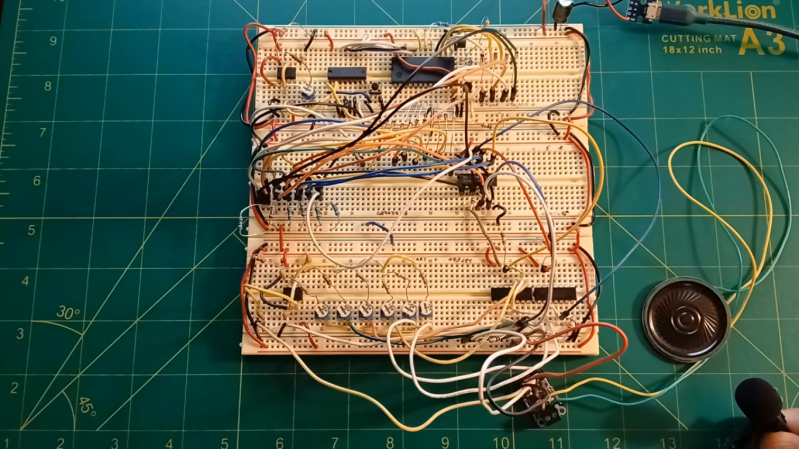
It’s technically true that any piece of software can be reproduced in hardware, although modern software’s size and complexity generally makes this a non-starter. But if we go far enough back in time, older software becomes easier and easier to implement in hardware. The original DOOM from 1993 might one day be recreated in full this way, but that day is not today. Instead, [Nick] has recreated the original music from that game, playing the opening track in nothing but 555 timers.

The circuit starts with a 555 timer that acts as a system clock with a rate of just over 7 Hz. These pulses feed a binary counter which in turn feeds a decoder, giving the circuit 15 positions. Each output of the decoder feeds to a diode matrix which stores information about what pitch the circuit should play. The circuit only needs to play six pitches so the diodes effectively connect each moment in time to one of these six notes. From there the circuit feeds into a set of switches which select different resistor networks of another 555 which is actually responsible for producing sound. The resistor networks have different values to adjust the timing of the 555 to produce different pitches.

Of course this entire exercise is largely academic as almost any microcontroller would be able to be programmed to play this chiptune quite easily, but it’s not a bad idea to get down into the weeds of digital logic from time to time in order to refine one’s skills and knowledge about what’s really going on in the inner workings of circuits. Or, go even deeper than that and build the logic gates themselves from first principles.


Casting Engine Parts from 3D Prints

August 28, 2026 0

After building a couple of internal combustion engines by milling billet aluminium stock and cringing at the absolute waste of material this created, [Camden Bowen] figured he’d give casting metal parts a shot. Of course, the key here is to create the molds for said casting, which is where you got a few options available.

Since DIY is really his thing, he also made his own kiln using cement and perlite, plus a propane burner. For the aluminium material to melt, he bought a stack of aluminium alloy wheels, as these are made of an alloy that’s actually suitable for casting. These were turned into ingots as a first step towards casting the engine parts, which among other things helps to purify the metal.

For the actual casting method he picked lost PLA, meaning the intended shape is 3D printed in PLA, then put into plaster before it’s melted out of the newly minted mold in an oven and subsequently burned out in the kiln. For the plaster [Camden] used regular Plaster of Paris, mixed with sand to give it suitable heat-resistant properties.

After some trial and error, as well as a lot of trouble burning out all the PLA, he got a usable mold and managed to eventually cast an engine cylinder with only a few imperfections. Considering just how convoluted it would have been to mill that part out of billet aluminium, it’s easy to see why commercial manufacturers are casting such parts as well.


Building a Headless Game Boy Emulator

August 28, 2026 0

[Artificial-Age] has built a rather unique way to play old Game Boy games. It’s an emulator, but it doesn’t work in quite the way you might think!

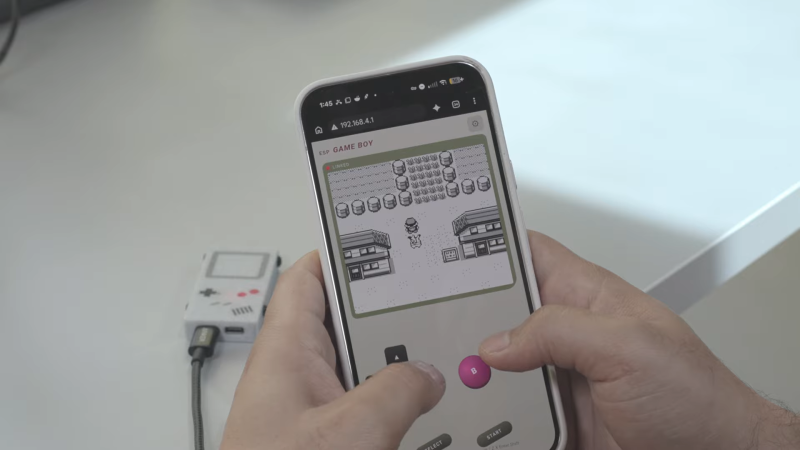
Since the Game Boy is a relatively simple 8-bit machine that runs at a leisurely 4 MHz or so, it is well within the capabilities of an ESP32 microcontroller to emulate. [Artificial-Age] got an ESP32-S3 and programmed it to do just that. However, there’s a twist—there is no screen hooked up to the microcontroller, nor any buttons. Instead, the board is accessed over a WiFi access point that it hosts itself.

One then opens a web browser, which streams the emulated video and audio from the console, while accepting button inputs from your keyboard or touchscreen, depending on the platform you’re viewing the web interface on. ROMs are stored on the ESP32’s flash storage, and can be uploaded via the web interface.

It’s an interesting setup, and one that perhaps doesn’t make obvious sense at first. After all, any modern smartphone can easily emulate a Game Boy, too. However, this setup makes it easy to share the emulator with other people, who can simply check out the WiFi AP and web interface without having to download or or install anything on their own device. We’ve featured some other fun emulation projects lately, too.


Thursday, August 27, 2026

Rooftop Camper For Roofless Vehicle

August 27, 2026 0
Rooftop Camper For Roofless Vehicle

The Honda Goldwing is one of the more famous motorcycles ever produced. It’s known for its reliability and comfort, but also for being one of the first motorcycles Honda rolls out new technology with. It was the first to have a factory-installed airbag as well as integrated GPS, and is now largely associated for being a sort of two-wheeled RV with how many creature comforts it supports for long-distance riders. [Matt] has a Goldwing of his own, and is taking that RV-like feeling to the extreme with a rooftop camper for this motorcycle.

Of course, motorcycles don’t have roofs, but if this Goldwing had one this camper would definitely be above that. Goldwings are already heavy enough without an enormous weight dramatically increasing the center of gravity, and [Matt] certainly had his problems with that along the way. But before this adventure he had modified it into a hill climber, removing a lot of the extraneous equipment from it. Attaching some metal frame and a lightweight camper shell to it didn’t seem like too much of a stretch from there, so he got to work with a welder. At the end he has a box that’s just barely big enough for him to sleep in but is more or less functional as a camper.

Perhaps unsurprisingly, [Matt] dropped this more than once on its maiden voyage, and one of those falls damaged a wiring harness that caused his battery to drain in the night. Luckily he was not too far from home on the test drive. We’d tend to think that this camper won’t be one that [Matt] keeps working on (although we’d imagine a tricycle kit might solve his center of gravity issues) but since he’s built some other interesting campers in the past we’re not too sure we’d count this one out just yet.


The Mactini: A Computer That Does Almost Nothing

August 27, 2026 0

Recently [Tucker Osman] brought to life what once was just a meme created by the BBC as it poked fun at Apple’s push for ever smaller devices that also dropped many features along the path towards questionable innovation. This ‘Mactini’ was a super-small laptop, with just a single button that did everything, befitting the overpriced more-money-than-sense status symbol vibe that [Jony Ive] brought to Apple.

The input method suggested in the BBC video involves convoluted patterns using the single button, which would be functional, albeit cumbersome. Even as [Tucker] set out on this mission to make the Mactini real, he had to answer a lot of questions, while sticking to the rules that it had to follow the rough form factor of the original and have the same features.

In lieu of overcomplicating things, he opted to use a 1.69″ ST7789V2-based SPI LCD along with a small RP2350-based board from Waveshare for the brains. Rather than just slapping the LCD example for the Pico board on it as firmware, he actually used DMA to do the screen data copying, freeing up a lot of CPU cycles.

The rest of the hardware was cobbled together from e-waste parts, including an iPad speaker and an audio amplifier from a scrap board. Video was handled using Motion JPEG decoding for a not-horrible-framerate. All of this was put into a 3D printed case that was designed in FreeCAD, to make the Mac that [Ive] could only have dreamed of back in the 2000s.


The Farador Quack Medical Device

August 27, 2026 0

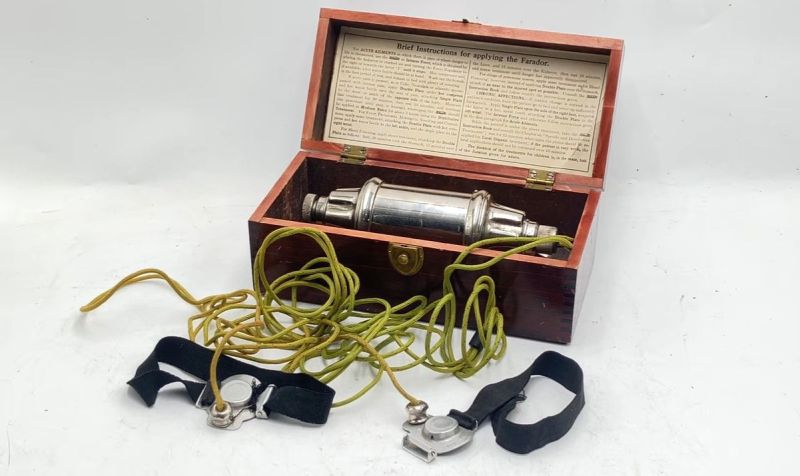
Over the centuries there have been an incredible number of purported medical devices released onto the market, with some having more outrageous claims than others. Released in the 1910s and produced into the 1920s, the Farador electrotherapeutic device claimed to be a thermoelectric device that would cure all disease conditions. In a recent video over at the [Our Own Devices] channel we get an in-depth look at this device and its usage instructions.

It's a thermoelectric generator. Sort of. (Credit: Our Own Devices, YouTube)
It’s a thermoelectric generator. Sort of. (Credit: Our Own Devices, YouTube)

On the Smithsonian’s website you can see the version they’ve got. It’s not identical, but the working principle remains the same — after bypassing the whole ‘is this the right treatment’ questionnaire because it’s a cure-all device, you take the main metal device and its connected electrodes out of the box.

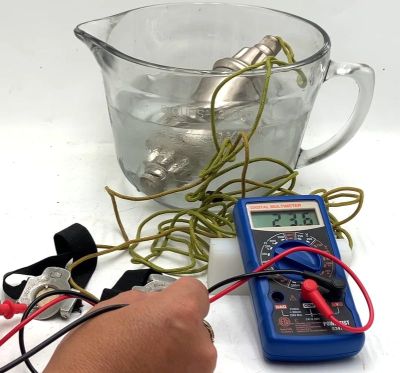
Unlike similar devices of the era that applied an actual electrical current using batteries or similar, this Farador purportedly uses thermoelectric power generation, but there’s no clear hot or cold side to what would be the generator. Despite this, about 20-30 mV can be measured across the electrodes, so surely it’s working?

As it turns out, the Farador is just one of many fake medical devices that cloned the original Electropoise. Naturally such devices have been disassembled by many over the past decades, and as it turns out they are all empty inside, or at least devoid of any mechanisms. Much like many of such fake medical devices today, they mostly bank on the placebo effect. This placebo effect can be so strong that it’s even a confounding factor in real medical trials and medicine.

The more involved and complex the purported medical treatment seems, the stronger the effect tends to be. For the Farador the complex instructions, apparently high-tech thermoelectric generator and such all help to create the illusion and could thus be construed to be the main feature of this product.