Wednesday, September 2, 2026

How a 1981 RAM Expansion Worked

September 02, 2026 0

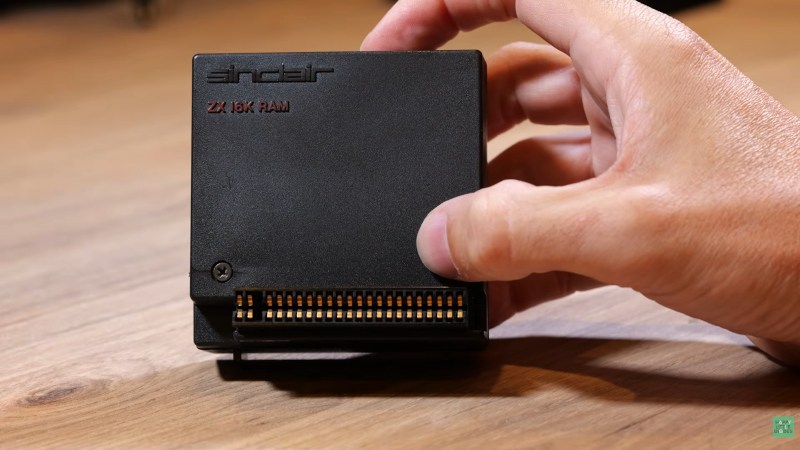
Sir Clive Sinclair and his company were notorious for pushing the limits of electronic parts in search of a low price, and his ZX series 8-bit computers were fine examples of this art. The ZX81 came with a meagre 1K of memory, and a popular upgrade was a 16K RAM pack. [Happy Little Diodes] has opened one up, and to his surprise, found many more parts than expected.

Inside the box is a pair of PCBs connected by ribbon cables, one of which has a selection of 74 chips and the other the 4116 RAM chips and a discrete component power circuit. This complexity comes from that cheapness, the 4116 is an inexpensive DRAM chip and requires an eclectic set of power supplies.

The functions of address selection are straightforward enough, as is the DRAM refresh circuitry. The power supply is clever in that it’s a self-oscillating switcher that provides +12 and -5 volts with a single transistor. We particularly like the quench diode in the 12 V Zener diode regulator  circuit.

The ZX81 gave a huge number of British kids their first taste of computing, and learning to use a limited memory space is something that stays with you for life. The film doesn’t mention the most notorious feature of the 16K pack though, that it had been developed with a machine clamped to the desk. Using one in a real-life location was an exercise in not jogging your machine, because the slightest disturbance would trigger a reset.

The ’81 was also famous for its membrane keyboard. Another popular upgrade back then was a new one.


Tuesday, September 1, 2026

How Gold Plastic Syndrome is Killing Toys and Game Consoles

September 01, 2026 0

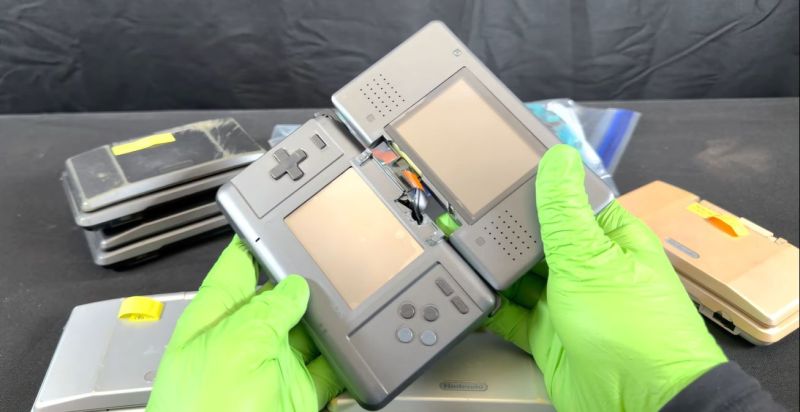
In a recent video [Sqwerks] does a deep-dive into the problem of disintegrating plastic enclosures of Nintendo DS consoles. These original NDS handheld consoles have a metallic-like coating that appears to interact with the ABS plastic, causing yellowing as well as extreme brittleness and correspondingly broken hinges. Unsurprisingly, this causes the shell to essentially disintegrate the moment you try to disassemble them for something like a screen replacement.

While somewhat the opposite of plasticizer migration into ABS from PVC insulation that we covered before, the underlying cause is probably similar, with the Transformers toy community having come to call it Gold Plastic Syndrome (GPS) based on the fact that it were mostly gold-colored parts on these plastic toys that seemed to be affected. Over time the additives used to add a cool metal sheen and swirls to the plastic appear to interact in a way that makes the ABS plastic very brittle.

Although the underlying cause of GPS doesn’t appear to be known yet, the Transformers community has documented this happening since the late 1980s and into the early 2000s, with even reports that some toys from the mid-2010s suffer from this. Whatever the underlying cause of GPS is, the result is always the same, with disintegrating brittle plastic and often a powdery residue.

In the case of NDS consoles, replacing the affected shell with a third-party replacement is still a viable option today, with [Sqwerks] recommending this solution. For other enclosures and toys where the plastic effectively is the toy, it might be that all we can do is watch them slowly disintegrate until we figure out how to revert GPS.


Reactive Heat and Wind Come to VR, Thanks to Smart Plugs

September 01, 2026 0
Reactive Heat and Wind Come to VR, Thanks to Smart Plugs

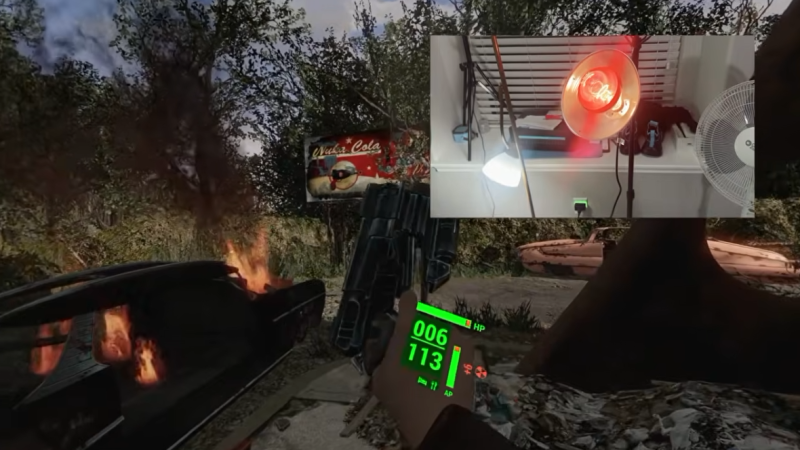
Want to feel the heat of nearby fire, explosions, or radiation? Or even just the gentle warmth and breeze of a sunny day in the wasteland? If you said yes, you’re in luck because [GingasVR] created an immersive heat mod and wind mod for the VR version of Fallout 4 that leverages economical smart outlets and game scripting to do just that.

The heart of this hack lies in gluing two things that don’t normally go together. In this case [GingasVR] uses a bit of game scripting to control TP-Link HS100 or HS110 Smart Plugs, allowing virtual events to control things in the real world. An ordinary fan in a smart plug creates wind on demand, and heat comes from a 250 watt infrared heat lamp aimed toward the player. For heat, an IR lamp is the way to go because it’s highly directional, can be quickly cycled on and off, and responds rapidly.

The range of immersive effects opened up by this is pretty compelling. Sunny weather yields a gentle glow of warmth, but nearby explosions cause a short full-blast flash of heat. The heat of fires also grows and fades with proximity. This being Fallout, [GingasVR] ensured local radiation has an effect on the heat level as well. Want to see it in action? She briefly explains around the 3:20 mark in this video.

Using ordinary appliances and smart plugs controlled from within VR to modify environmental effects is clever, and we like that it’s entirely nondestructive. The scripting mod for the game doesn’t overwrite any game files, and the hardware used requires no modifications.

Not into Fallout? [GingasVR] has similar Skyrim VR mod, if that’s more your bag. And if you’re modding Skyrim VR anyway, consider adding a “meditation device” headband to make magic respond to your actual state of mind.


Hackaday Europe 2026: Playstation 4 to Psychometer

September 01, 2026 0

There are many ways to detect stress in an individual. You can use self-reporting checklists, you could try and measure various vital signs like respiratory rate and pulse and infer things, or you could observe the levels of hormones like cortisol in the blood.

Or… you could pull some parts out of a Playstation 4, and get hacking. Edwin Hwu did precisely that, creating a device that can image the skin down to the nanometer and potentially even determine fine details about an individual’s health status. He came to Hackaday Europe 2026 to tell us all about it.

Look Closely

Edwin’s background is very relevant to this project. He worked in a research institute in Taiwan where he collaborated with the German National Metrology Institute, working on atomic resolution imaging on silicon wafers. When you’re doing sub-nanometer calibration work for the semiconductor industry, that’s serious stuff, as is the X-ray microscopy that Edwin has dived into. When it comes to looking at things at very tiny scales, he knows his stuff. He’s also done plenty of work on real-time cell culture monitoring, skin assessments, and even high resolution 3D printing. It’s a broad skill base that all fed into the project he came to Hackaday Europe to talk about.

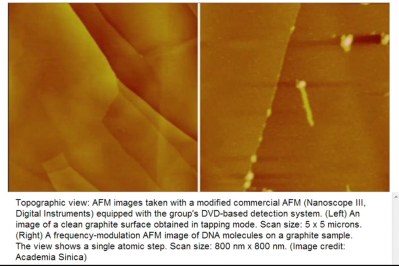
A single strand of DNA imaged with a DVD-based AFM setup. Credit: talk slides

There is a problem with optical microscopy that comes down to the diffraction limit of light—which means you can only image down to a resolution of around 1 micrometer. That’s why we use scanning electron microscopes for so many finer tasks, because the diffraction limit of electron beams is so much smaller. This allows the imaging of structures like carbon nanotubes or buckyballs, but with the limitation that the surface must be conductive and the imaging be done in a vacuum environment. A newer technology is the atomic force microscope (AFM), which involves using a very sharp probe with a tip of just 2-3 nanometers to actually touch molecules. This can be done without a need for a conductive surface or vacuum. When taking this approach to look at things on the nanometer scale, Edwin likens it to trying to poke a 1 euro coin with the tallest mountain on Earth. It’s a precise device with incredibly high resolution, but the average AFM costs half a million euros, and is incredibly bulky and slow at what it does. That is, unless… you find a way to build one on the cheap.

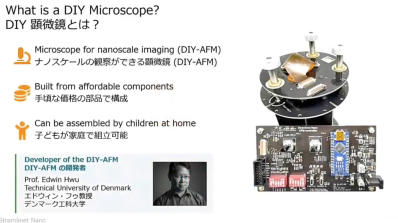
Atomic force microscopes were once incredibly expensive and cumbersome pieces of laboratory equipment. Now, it’s possible to build one yourself from an affordable kit, and it’s easy enough for children to put together. Credit: talk slides

Some time ago, Edwin created an atomic force microscope using the optical head of a DVD player, achieving a resolution of 0.39 nanometers. With this build, it was possible to image a single strand of DNA. Edwin also talks about how he used simple piezoelectric buzzers to create an ultrafine scanner for this work. The piezo elements are used for actuation, since they can be controlled to make incredibly minute movements. The work developed to the point where DIY AFM kits were made available at a mere fraction of the cost of traditional laboratory-grade installations.

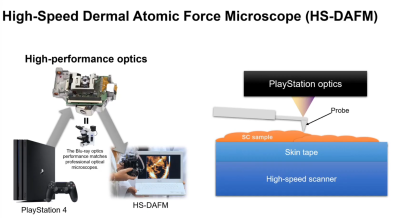
The Playstation 4 proved to be the perfect donor for a high-quality AFM build thanks to the performance of the Blu-Ray optical head. Credit: talk slides

This work spawned a greater plan. Through his talk, Edwin explains how he figured out that e-waste gaming consoles could be turned into cutting-edge atomic force microscopes. Specifically, the Playstation 4 was the perfect candidate, with its high-end Blu-Ray optical head which is capable of reaching the diffraction limit of light. The Blu-Ray optical head is used to monitor the movement of the AFM probe, while scanning it is achieved with a piezo rig just like the earlier DVD-based build. It also has the benefit that the Blu-Ray hardware is built for higher data rates, meaning it’s possible to stream data from the optical head much faster for a quicker AFM scan. Edwin refers to his build as the HS-DAFM—for High Speed Dermal Atomic Force Microscope—since it’s 100 times faster than traditional laboratory atomic force microscopes.

By looking at the skin at a nanoscale level, the tool is useful for investigating conditions like atopic dermatitis, among others. Credit: talk slides

The word “dermal” is important—because Edwin has put the build to use in examining skin nanotexture, for diagnostic purposes. His talk explains how, combined with machine learning systems, the tool can be used to investigate skin conditions and help in the diagnostic process. It’s also become useful from the perspective of cosmetics, and looking at how the skin looks at the nanoscale due to factors like aging and UV exposure. With the aid of machine learning tools, Edwin has found that it’s even possible to determine if someone has asthma with 75% accuracy, just from a skin scan. There is even an exploration of mental stress versus skin nanotexture, albeit in a very preliminary stage.

If you’ve ever wondered about the finer details of doing atomic force microscopy on the cheap, or how skin texture holds the secrets of so many health-related matters, Edwin’s talk is a great one. Sometimes thinking outside of the box and the limitations of commercial laboratory equipment can lead to wonderous things, as it did here!


It’s Teletext, But On The Radio

September 01, 2026 0
It’s Teletext, But On The Radio

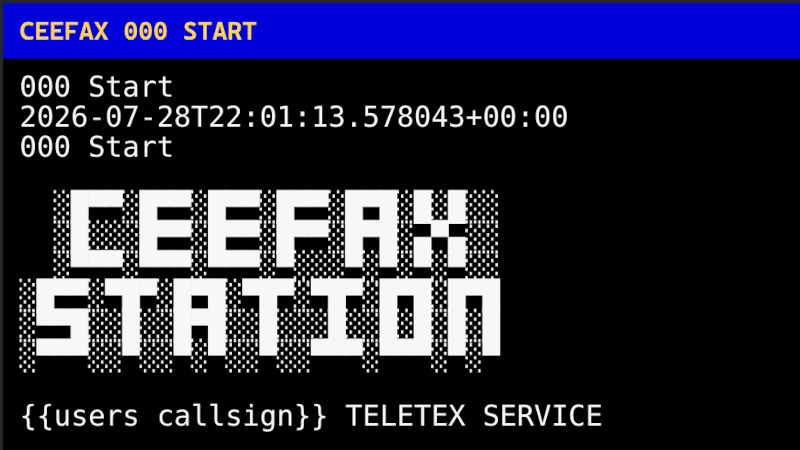
Old-school teletext with its pixelated text and block graphics may now be largely a thing of the past, but that doesn’t mean it’s without enthusiasts or there’s no more life in the idea. [M7TJF] has a project which takes teletext and puts it on amateur radio through the magic of AX.25. It’s called CEEFAX Station, in honor of the BBC’s teletext offering from back in the day.

What you get is a Linux package or a Windows executable, which you run and presumably hook the computer up to a radio. It can either be a transmitting node or a receiving one for browsing pages, and there’s an online map to track who’s doing either and on what frequencies. This is all brand new so there’s not much on there at the moment, but we expect that as people try this mode, this will change.

Sadly it’s a little unclear on how the protocol works and how the pages are encoded, but it’s early days. Meanwhile if you hanker for the real thing, it’s still about in some places.


Monday, August 31, 2026

Building An Energy-Harvesting Business Card

August 31, 2026 0
Building An Energy-Harvesting Business Card

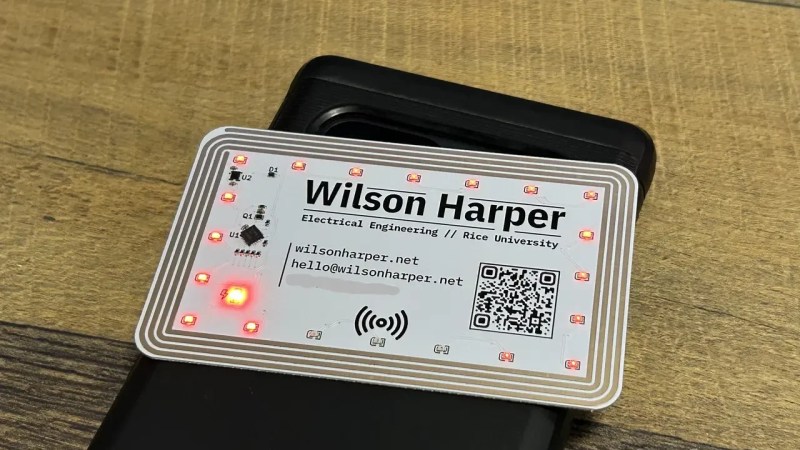
The hope is always that a good business card will leave a good impression. For those in the electronics field, they also serve as an opportunity to showcase creative design skills. [Wilson Harper] demonstrates that ably with a rather nifty energy-harvesting build.

The card is based around a thin PCB in the typical business card size. It’s populated by 21 Charlieplexed LEDs, a small microcontroller, and some supporting components. Now, this is normally where you might expect the device to be powered by a small coin cell, maybe deftly integrated into the PCB thickness itself to make the card less cumbersome. But no—[Wilson] went a different route. The thing is that in 2026, most of us are carrying phones with NFC readers built in. Thus, the card was built to harvest this source of energy with a PCB trace antenna, designed with the aid of STM’s antenna inductance tools and an LLM script lobbed into KiCad. All one needs to do is to pop the card on the back of a phone and the LEDs animate joyfully.

Design files are on Github for the curious. You might also like to check out some of the fancy business cards we’ve featured in the past. Of course, if you’re working on just such a project yourself, you’re more than welcome to send it in to the tipsline!


Simulating UAVs In Unreal Engine

August 31, 2026 0

When it comes to building real-world flying vehicles, testing can be arduous and expensive. You have to find somewhere to fly, then you have to contend with environmental conditions and the possibility of damaging your craft if things go wrong. Simulation is a great solution to this, allowing testing without so much risk. To that end, [AlexanderRex] whipped up a platform for testing UAVs from the comfort of your computer desk.

PteroSim is intended as a comprehensive test bench for simulating autonomous aerial vehicles. It can run PX4, ArduPilot, and Betaflight binaries right in the simulator. The autopilot code is given simulated sensor data, and in turn responds with actuator commands, just as it would in a real craft. The simulator runs the flight dynamics using JSBSim, and the resulting scene is rendered in Unreal Engine 5.

If you’ve ever wanted to quickly road test different autopilot settings without heading out to the field or risking hardware, this is a great way to do so. It’s hard to beat the speed of iteration that is possible when testing on the computer on your desk. We’ve featured similar work before, too.