Thursday, October 8, 2026

The 80s Called: They Say This DIY Phone Is, Like, Totally Rad

October 08, 2026 0
The 80s Called: They Say This DIY Phone Is, Like, Totally Rad

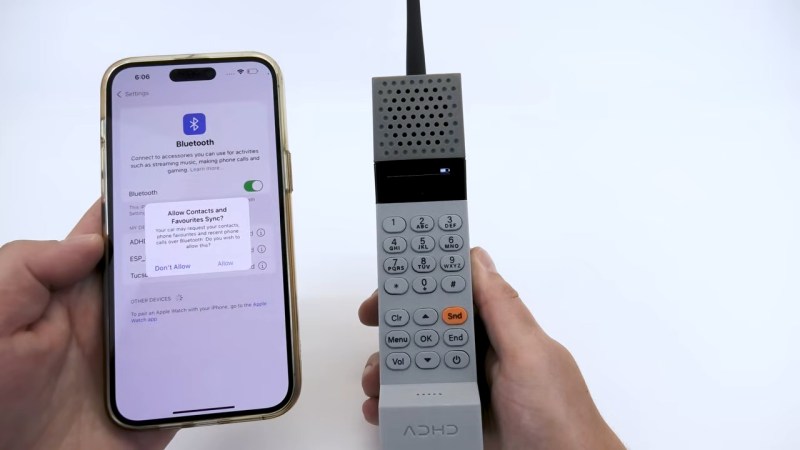
Like more than a few of us , [Kevin Noki] is sick of being pulled out of flow state by that annoyingly addictive black rectangle we all carry around. His solution was to build a phone to escape his phone, in a YouTube video we embedded down below. We’d say that phone is straight out of the 1980s, except it’s not quite a phone. It would perhaps be more accurate to say he’s building a Bluetooth handset– actual telephony remains the province of a professional device with regulatory approval, because getting custom hardware on VoLTE is a nonstarter in many places.

He starts out using an ESP32, because he already had one and why not? It’s got bluetooth, after all. Alas, audio quality he was getting through it was a little too crunchy, so he pivoted to use a dedicated Hands Free Profile (HFP) bluetooth module that is purpose built for exactly this kind of application. He’s selling the design on his website, but given how much detail he shows on screen, recreating your own version would be easy enough to save the quid. You’d be missing out on the STL for the fantastic 80s brick he’s made, which may be the most interesting part of the build to us.

We’d likely have jumped right to CAD and printed out a few iterations of the case until we were happy, but [Kevin] takes a more traditional industrial-design approach, mocking up the phone with XPS foam and a manually-operated hot wire cutter. It’s not a step we see makers take very often, but it pays of here– at least for subtracting material, it’s a very quick way to iterate, and he only needs to do one 3D print for the final version. We also like very high-tech acrylic bending jig, which he uses to put some black LED acrylic over the display.

It’s a lot of work to make you less-likely to grab a phone you still need anyway– remember, there’s no cellular modem in this– but, hey, it beats torturing yourself, or worse, a tamagotchi.



Digital Signage in the Browser With Just a Click

October 08, 2026 0
Digital Signage in the Browser With Just a Click

There are many ways to display text on a computer screen, but most require at least some manual effort from the user. It’s annoying enough even if you’re dealing with one machine, but it gets even more of a hassle when you’re trying to display something on multiple devices of varying size and capability. That’s where BIGWORDS.PAGE by [SpeakingOfBrad] comes in.

It’s essentially a simple web page you can control via a carefully crafted URL, letting you create all sorts of text displays you can “distribute” to browsers on other devices with a simple link. So, for example, if you wanted to let everyone see what your favorite website is, you need only point the browser on your phone or laptop to https://bigwords.page/#Hackaday. As the image at the top of this post shows, you can also change the font and text colors by adding a few more values.

It’s an easy enough style of markdown that you can manually throw together links without much trouble, but there’s also a visual editor that will spit out a finished link once you’re happy with how it looks. Beyond simple text strings, you can also show images, create countdown timers, and even produce animated presentations that work across multiple pages of information.

The project is released under the MIT license, and the documentation includes instructions for self-hosting your own version. For most folks, that’s probably not necessary, but we can see it being useful if you want to support a number of displays on a local network without having each one connect to the Internet.

If you’re looking for a similar concept on a smaller scale, we recently covered a clever technique for pushing your own content out to a cheap desktop notifier.


With Latest Update, Alexa Refuses to Pass the Aux

October 08, 2026 0
With Latest Update, Alexa Refuses to Pass the Aux

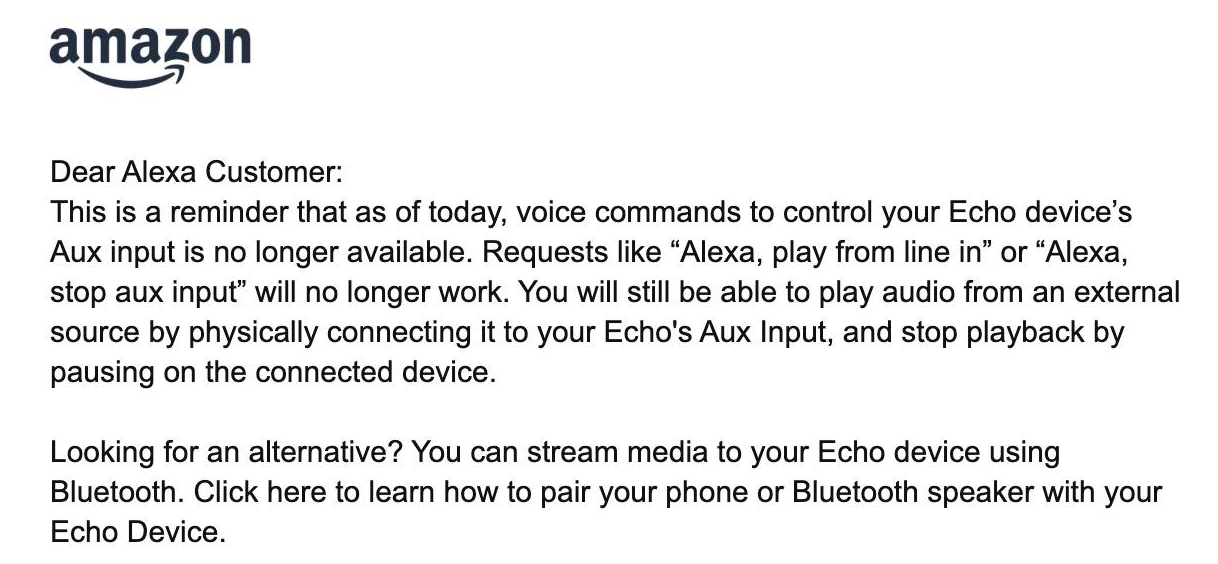
Although the feature has been deleted from newer models, there was a time when Amazon’s Echo devices included a 3.5 mm “aux” input jack that let you connect other audio sources to the smart speaker. Alexa would even let you switch over to an external source with a voice command — or at least, it used to.

As first reported by Reddit user [n8-sd], Amazon has started informing users that voice control over the 3.5 mm jack is no longer supported. While the physical input will still function on models equipped with it, if you want to mute the audio coming from an external device you’ll have to wade through the Alexa smartphone application to do it.

In a statement to Ars Technica, an Amazon rep confirmed that voice control over the auxiliary input has been removed as of the latest software version, and that their analytics showed not many people were using the feature in the first place. They also pointed out that no changes have been made to voice control of Bluetooth devices. While we don’t doubt that the total number of users that were physically plugging an audio source into their Echos was probably low in the grand scheme of things, that doesn’t really explain why such a simple feature needed to be actively removed.

Some commenters have theorized that the real reason behind the change is the fact that Amazon has no way of monitoring what users are playing over the auxiliary input. Since cataloging and selling the media consumption habits of users is big business these days, that’s a problem. While they might prefer to disable the feature entirely, they know that would stir up some bad press, so they’re opting to simply make it more annoying to use. We’re not saying we entirely buy this explanation, but it’s not the craziest thing we’ve ever heard either.

Although the Echo devices have never been particularly hackable, they have enjoyed a certain amount of success with tech-savvy users, making it all the more disappointing to see the ecosystem seemingly becoming less capable over time.


Wednesday, October 7, 2026

Streaming Games Means the Nintendo DSi Will Never Be Obsolete

October 07, 2026 0

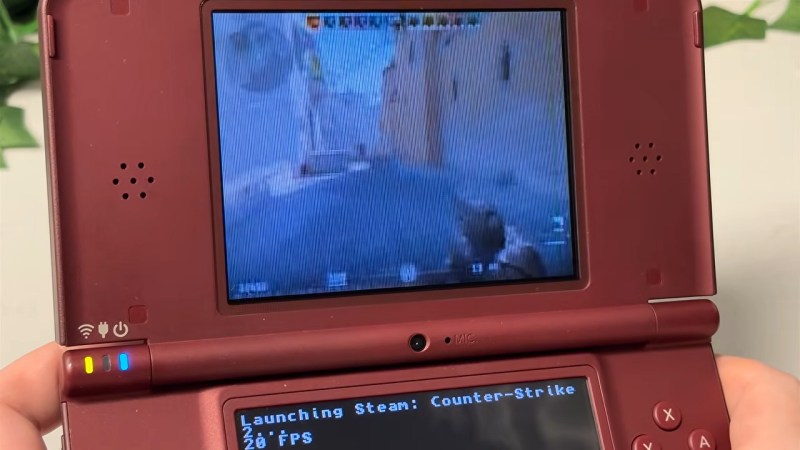
There comes a point where you have to acknowledge that your beloved console is out of date and– barring the odd homebrew title– won’t be playing new games ever again. You’d think that Nintendo’s 2008 DSi handheld would be in this category, but [gavff64] has a workaround. What if the odd homebrew title streamed games over the network?

At its core the RNDS-Stream is just decoding an MJPEG stream from a server on a Linux PC, giving you the content of an X11 or xWayland window with relatively low latency at around 15-20FPS. So while you won’t be entering any e-sports tournaments, you can enjoy more relaxed, casual games like Counterstrike. Well, at least there’s no audio streaming yet, so you won’t have to hear the other team’s trash talk. That ought to make it more relaxed.

Sound may come; the project is very much a work in progress, and also a showcase of RubyNDS, [gavff64]’s Ruby-based homebrew framework for the DSi. Why Ruby? Why the DSi? For no other reason than [gavff64] likes both of those things.You can observe it in action after 4:48 in the video embedded below– just be warned, it’s editing is tuned to a TikTok-using audience and won’t be to everyone’s taste. Don’t let videography get in the way, though, because the hack is the thing and it’s up on GitHub for all and sundry under an MIT license.

The DSi is no stranger to hackers, having gotten its first flash cart the year of its release. In spite of that, we’ve seen surprisingly little homebrew for the dual-screen device, this augmented reality app being an exception.


Handheld Atari 2600 Packs a CRT

October 07, 2026 0

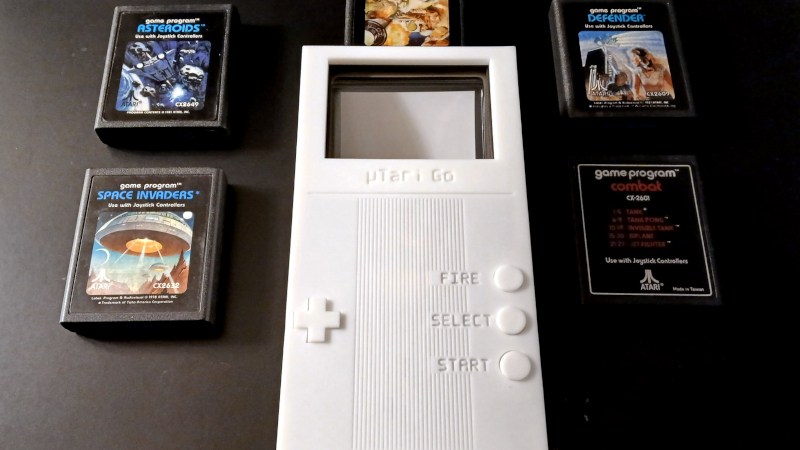
We covered [Nick Bild]’s mini Atari console using original devices not so long ago, and today he’s back with the same console wrapped up with a CRT as a handheld. It would have cost a fortune in D cells to own back in the day, but we know we’d have lusted after one of these in 1979.

He’s called it the µTari Go, pronounced “Microtari”, and it’s a 3D printed affair with the buttons roughly where you’d expect them if you’re used to the Game Boy, and a cartridge socket at the top above the screen.The PCB is the circuit of the original packed into a smaller space, so his claim of using original hardware is valid. The CRT is one of those Sony flattened modules that can still be found in the usual online bazaars, and it packs a small speaker. He’s not been foolhardy enough to equip it with those D cells, so the power is an external 12 V jack.

You can’t not like this project, especially after seeing it in action in the video below. Unlike in the ’70s a USB-C power pack could run this thing with reasonable playing time, so it could even be fully portable if you wanted. You can see our write-up of the board itself here.


Repairing a Couple of Very Expensive Registered DDR5 RAM Sticks

October 07, 2026 0

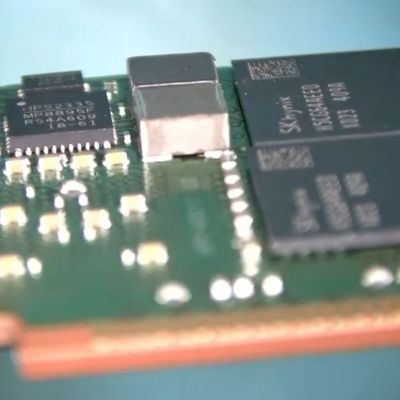
It’s definitely a sign of the times when repair shops get handed sticks of registered ECC DDR5 RAM by businesses to try and fix, rather than just tossing the defective ones and slotting in a fresh bunch. This is how [northwestrepair] ended up with two of these ECC RDIMMs, with a current market valuation of a rather nice budget car.

The 128 GB stick was first on the bench, with the fault being that it would fail DDR5 training on boot. This suggests that one or more of the DRAM BGA packages had developed a cracked solder joint, which is something that you could conceivably fix with more diagnosing and testing for a single IC reballing.

In this case doing a reflow cycle was enough to bring the RAM back to life, with the DDR5 training now passing without issues in a test system.

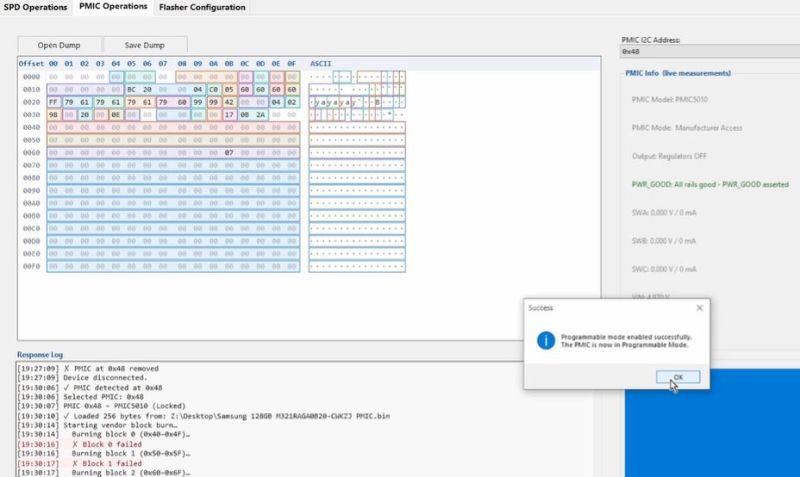
For the 256 GB stick things wouldn’t be so easy, as it seemed completely dead. This suggested a dead PMIC, as this is the component on DDR5 RAM responsible for ensuring that the DRAM ICs even power on. The SPD ROM was another option, so that got swapped first, which does require reprogramming the RDIMM. For this the earlier SPD dump image was reflashed, but swapping this chip made no difference.

After some additional reflowing of a few suspect ICs, still nothing happened. Following this a lot of reballing and other troubleshooting steps followed, only for the problem to be one shorted MLCC and a broken PMIC, potentially caused by whoever dropped said RDIMM onto the server room floor.

Cracked MLCCs do appear to be a very common cause of failures, as they’re often used as filter capacitors, same as for this RDIMM. Checking for shorts across a number of such MLCCs can be a good way to shorten a diagnostic cycle. Since this RDIMM was dropped, reballing every IC probably was still a good move as this may have cracked some solder balls.


2026 Retrocomputing Challenge: Dungeons of Daggorath, But Without Quite So Much Typing

October 07, 2026 0
2026 Retrocomputing Challenge: Dungeons of Daggorath, But Without Quite So Much Typing

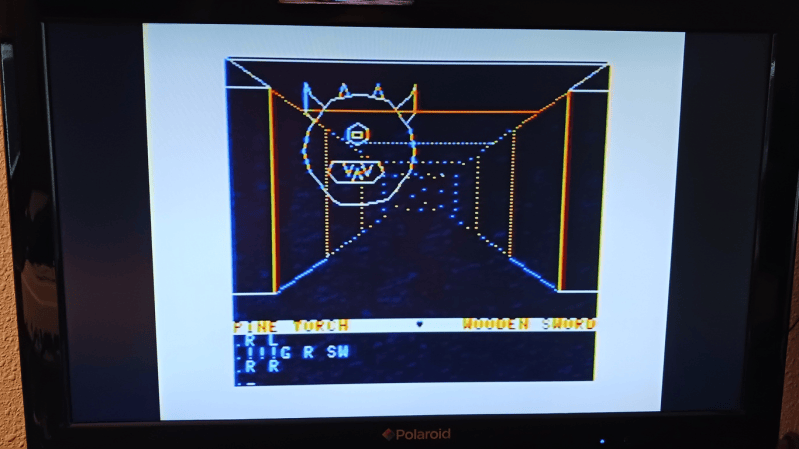
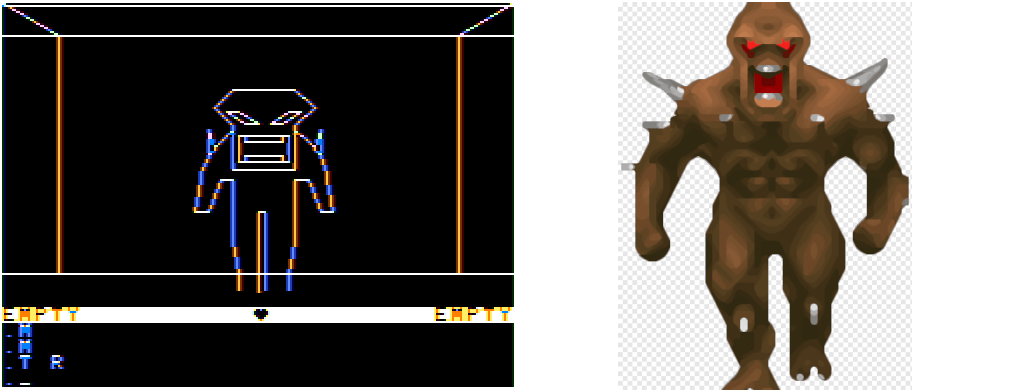
People mod games all the time, but it’s not every day someone mods Dungeons of Daggorath for the TRS-80. [Nick Bild] did exactly that, adding joystick support and a couple DOOM-inspired monsters for good measure. And while he was at it, optional unlimited player health and power because why not?

A pretty good representation, in our opinion.

Dungeons of Daggorath was pretty unusual for its time. It portrayed a dungeon and its contents from a first-person perspective, and events progressed in real time.

Gameplay-wise, most commands entered by the player revolved around moving around and attacking monsters, and that was done with text commands like ATTACK RIGHT which could mercifully be shortened to A R. Still, not the most efficient control scheme.

[Nick] downloaded the original source code and made several modifications. A joystick moves the player much more efficiently, with the button acting as a shortcut to attacking with whatever is in the player’s right hand. He also replaced the spider and viper enemies with creatures inspired by DOOM‘s imp and cacodemon monsters, as well as the aforementioned optional limitless health and power.

[Nick] dubbed the modified game Dungeons of Doom and while the terms of the original don’t allow redistribution of modified code, his changes are simple enough to follow. Especially so for those from the generation that remembers typing programs in by hand from a magazine page.