
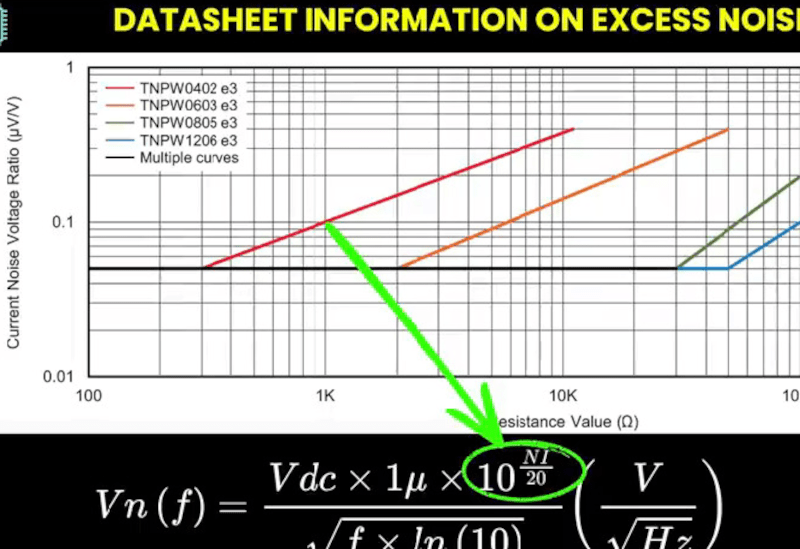
[Hans Rosenberg] has a new video talking about a nasty side effect of using resistors: noise. If you watch the video below, you’ll learn that there are two sources of resistor noise: Johnson noise, which doesn’t depend on the construction of the resistor, and 1/f noise, which does vary depending on the material and construction of the resistor.
In simple terms, some resistors use materials that cause electron flow to take different paths through the resistor. That means that different parts of the signal experience slightly different resistance values. In simple applications, it won’t matter much, but in places where noise is an important factor, the 1/f or excess noise contributes more to errors than the Johnson noise at low frequencies.
[Hans] doesn’t just talk the math. He also built a simple test rig that lets him measure the 1/f noise with some limitations. While you might pretend that all resistors are the same, the test shows that thick film resistors produce much more noise than other types.
The video shows some rule-of-thumb lists indicating which resistors have better noise figures than others. Of course, resistors are only one source of noise in circuits. But they are so common that it is easy to forget they aren’t as perfect as we pretend in our schematics.
Want to learn more about noise? We can help. On the other hand, noise isn’t always a bad thing.


No comments:
Post a Comment