
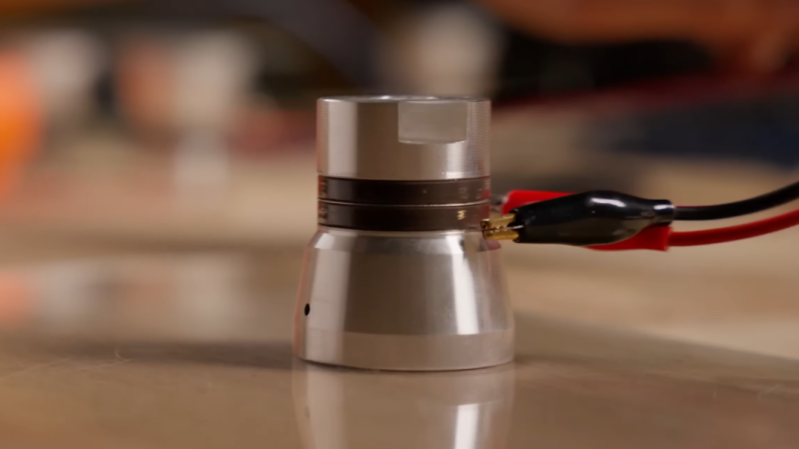
Ultrasonic levitation is by now a familiar trick: one or more ultrasonic transducers create a standing wave, and small objects can be held in the nodes of this standing wave. With a sufficiently large array of transducers, it’s even possible to control the movement of the object. This isn’t the only form of ultrasonic levitation, however, as [Steve Mould] demonstrated with his ultrasonic air hockey table.
This less familiar form of levitation was discovered by [Bob Collins] while working on torpedo guidance systems: when he tried to place a glass lens on an ultrasonic transducer it immediately slid off. He found during further experimentation that an ultrasonic transducer would levitate over any sufficiently flat and smooth surface. It works by trapping a very thin layer of air between the transducer and the smooth surface. When the transducer moves sharply toward the surface, it compresses a layer of air in between, and forces some air out, and the reverse happens while pulling back. However, during the downstroke, the gap through which air can escape is narrower than during the upstroke, and there is more surface-induced drag, meaning that the inflow and outflow of air through a narrow gap isn’t completely equal. At a certain distance, inflow and outflow balance, and the transducer floats on a thin layer of air.
In [Steve]’s air hockey arena, the floor oscillates and the pucks levitate over this. Driving it using just one transducer didn’t work, since the floor formed standing waves, and the pucks would get stuck on node lines. Instead, he used two transducers, one at each end of the arena, and drove them out of phase with each other. This created a standing wave and minimized dead spots.
The arena was a bit small (having to be played using toothpicks), but it seemed to work well. If you prefer your air hockey a bit more human-scaled, we’ve seen a table build before. We’ve also seen ultrasonic levitation before, ranging from simple electronics kits to the driving force behind a full volumetric display or photography station.


No comments:
Post a Comment