
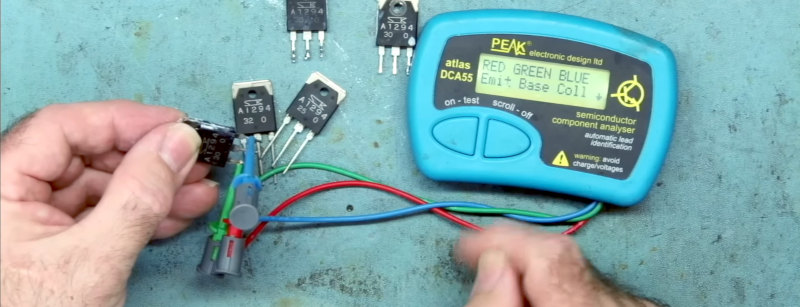
Transistors in some circuit configurations work together and, frequently, need to be matched. This is so common that you can sometimes find ICs that are just a pair of transistors made with the same piece of silicon, so they should be matched very closely by default. But with discrete transistors, two devices of the same type are not always identical. [Learn Electronics Repair] covers the topic and explains how to match devices in the video below.
Depending on the circuit, the matching parameters may be different, but generally, the idea is that you want similar gains or matching saturation characteristics. The reason is that when you have multiple transistors working together, you don’t want one to do more work than the other device. This is inefficient and could drive the “better” component to fail.
The same idea applies in bridge circuits, where you might match resistors or capacitors to make sure that, for example, two 10% resistors are very close to the same value. A 10K resistor could be between 9K and 11K, and you might not care as long as they are both, say, 9.2K or both 10.8K.
This is different, by the way, from impedance matching, where you achieve maximum power transfer by matching a source to a load.


No comments:
Post a Comment