
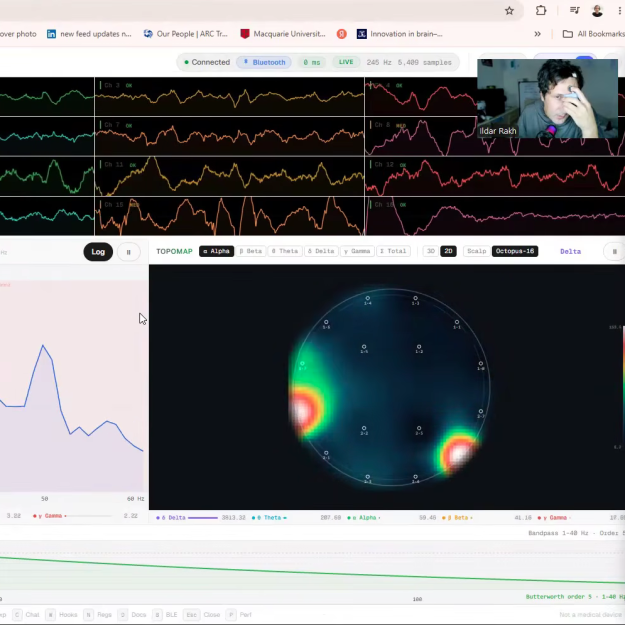
These days, most of us interface with our computing devices in the same old-fashioned ways—via keyboards, mice, and touchscreens. The idea of a more direct brain-to-machine interface remains appealing to many. [Ildar Rakhmatulin] and [Youssef El Abbass] have been working on just such a device, with an eye to using it for gaming.
The device is referred to as Octopus 16, so named because it combines sixteen EEG electrodes into a single compact package, along with the required common reference and ground. The contacts themselves are pogo pins, assembled into a coin-sized cluster. The device is strapped to the head, pushing the contacts against the scalp, and data from the electrodes is then siphoned off to a host machine via Bluetooth Low Energy. The EEG signals are picked up with a pair of Texas Instruments ADS131M08 ADCs, each with 8 channels, with a resolution of 24-bits to capture fine detail in whatever the brain is doing. An ESP32 microcontroller is responsible for grabbing the ADC output and trucking it out over Bluetooth.
The rig is designed for use with the PiEEG software platform. The team have experimented with the device, showing it off by using the EEG signals to detect an individual’s focus state and using that to feed into simple game environments.
Ultimately, what has been shown so far is not so different from the old Force Trainer toy, but the design might prove useful if you’re looking into doing EEG experiments on a budget. Just do your due diligence to make sure you’re getting more signal than noise out of those lovely 24-bit ADCs. Video after the break.


No comments:
Post a Comment